
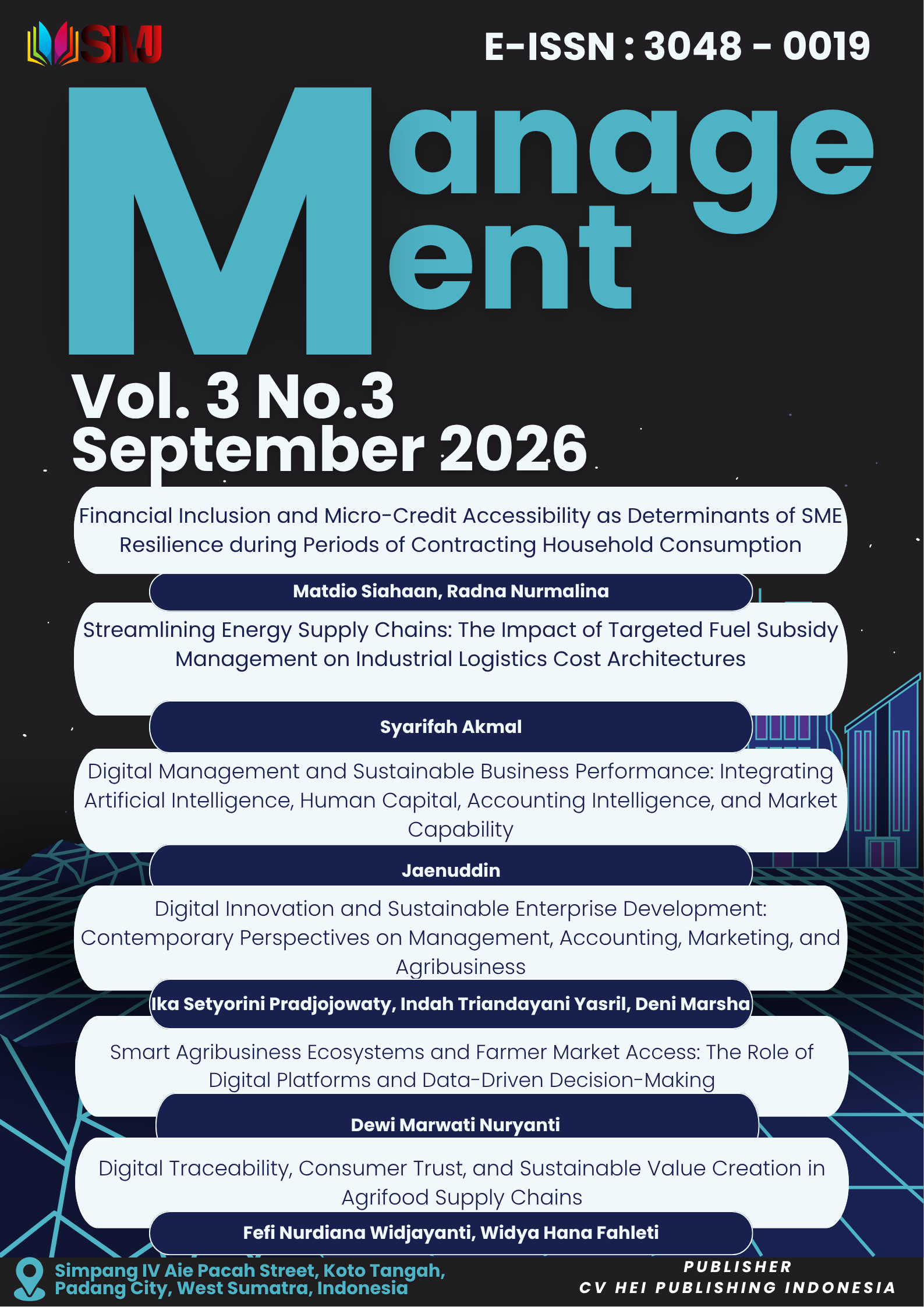
Streamlining Energy Supply Chains: The Impact of Targeted Fuel Subsidy Management on Industrial Logistics Cost Architectures
DOI:
https://doi.org/10.70076/simj.v3i3.210Keywords:
fuel subsidy, targeted subsidy management, energy supply chain, industrial logistics, logistics costs, fuel prices, supply chain efficiencyAbstract
Energy costs are a critical component of industrial logistics expenditures, as fuel prices directly affect transportation, distribution, and supply chain operations. In developing economies such as Indonesia, fuel subsidies have traditionally been implemented to maintain energy affordability and support economic stability. However, broad-based subsidy schemes may create market distortions, encourage inefficient energy consumption, and increase fiscal burdens. This study aims to analyze the impact of targeted fuel subsidy management on industrial logistics cost structures and supply chain efficiency. A qualitative Systematic Literature Review (SLR) was conducted by examining scientific literature on fuel subsidies, energy pricing, industrial fuel consumption, logistics costs, transportation costs, and energy supply chain management. The literature was selected based on thematic relevance, publication quality, and alignment with the research objectives. The findings indicate that fuel prices significantly influence industrial operating costs, particularly through transportation and distribution activities. Inefficient subsidy mechanisms may distort energy consumption patterns and reduce incentives for industrial firms to improve energy efficiency. Conversely, targeted fuel subsidy management has the potential to improve energy resource allocation, minimize cost distortions, and support more efficient supply chain operations. Its effectiveness, however, depends on accurate beneficiary identification, reliable distribution systems, effective monitoring, and policy coordination between the energy and logistics sectors. This study concludes that targeted fuel subsidy management can contribute to more efficient industrial logistics cost structures and improved supply chain performance when subsidy allocation is aligned with industrial needs, fuel consumption patterns, and broader energy efficiency objectives.
References
M. Ichsan, M. Lockwood, and M. Ramadhani, “National oil companies and fossil fuel subsidy regimes in transition: The case of Indonesia,” The Extractive Industries and Society, vol. 11, Art. no. 101104, 2022, doi: 10.1016/j.exis.2022.101104.
T. B. Sumarno, P. Sihotang, and W. Prawiraatmadja, “Exploring Indonesia’s energy policy failures through the JUST framework,” Energy Policy, vol. 164, Art. no. 112914, 2022, doi: 10.1016/j.enpol.2022.112914.
M. Calì, N. Cantore, L. Iacovone, M. Pereira-López, and G. Presidente, “Too much energy: The perverse effect of low fuel prices on firms,” Journal of Environmental Economics and Management, vol. 111, Art. no. 102587, 2022, doi: 10.1016/j.jeem.2021.102587.
P. P. Widodo and T. Kudo, “The impact of fuel price on energy consumption on Indonesia’s industries: A firm-level analysis,” Journal of Economic Education, vol. 11, no. 2, pp. 420–436, 2022, doi: 10.15294/jeec.v11i2.68940.
S. Santoso, R. Nurhidayat, G. Mahmud, and A. M. Arijuddin, “Measuring the total logistics costs at the macro level: A study of Indonesia,” Logistics, vol. 5, no. 4, Art. no. 68, 2021, doi: 10.3390/logistics5040068.
N. I. Saragih and P. Turnip, “Measurement model for national logistics cost of Indonesia,” Journal Industrial Servicess, vol. 10, no. 2, 2024.
J. Cheng, K. Si Mohammed, P. Misra, M. Tedeschi, and X. Ma, “Role of green technologies, climate uncertainties and energy prices on the supply chain: Policy-based analysis through the lens of sustainable development,” Technological Forecasting and Social Change, vol. 194, Art. no. 122705, 2023, doi: 10.1016/j.techfore.2023.122705.
F. Surury, A. Syauqi, and W. W. Purwanto, “Multi-objective optimization of petroleum product logistics in Eastern Indonesia region,” The Asian Journal of Shipping and Logistics, vol. 37, no. 3, pp. 220–230, 2021, doi: 10.1016/j.ajsl.2021.05.003.
R. A. Machfudiyanto, F. Muslim, W. P. Humang, N. Wahjuningsih, I. Kamil, M. Ichsan, and Y. Y. Adi Putra, “Optimization of the risk-based small-scale LNG supply chain in the Indonesian archipelago,” Heliyon, vol. 9, no. 8, Art. no. e19047, 2023, doi: 10.1016/j.heliyon.2023.e19047.
Y. Sofiyandi, Y. R. Kurniawan, and M. H. Yudhistira, “The impact of maritime logistics subsidy on food prices: Evidence from Indonesia,” Economic Analysis and Policy, vol. 79, pp. 1026–1045, 2023, doi: 10.1016/j.eap.2023.06.035.
E. Mawandi, D. P. Putri, Z. D. Swariarga, and H. S. Amarilies, “Comparative study of biosolar distribution cost: A case study at PT Pertamina Jambi Fuel Terminal,” in Proc. Int. Conf. Sustainable Engineering, Infrastructure and Development (ICO-SEID), Jakarta, Indonesia, 2023, doi: 10.4108/eai.23-11-2022.2338890.
T. P. Simatupang, “Dampak jangka pendek program bahan bakar minyak satu harga terhadap biaya transportasi di daerah tertinggal Indonesia,” Jurnal Ekonomi dan Kebijakan, vol. 18, no. 2, 2023.
N. Nursyifa, A. Febrianti, M. C. Chalia, and A. H. Sasmita, “Strategies to improve logistics cost efficiency in Indonesia,” Journal of Logistics and Supply Chain, vol. 3, no. 1, pp. 23–34, 2023, doi: 10.17509/jlsc.v3i1.62207.
H. Hassani, M. Sattar, A. Odulaja, and W. M. Santoso, “A statistical approach for a fuel subsidy mechanism,” Energy Policy, vol. 119, pp. 666–673, 2018, doi: 10.1016/j.enpol.2018.04.012.
R. A. Syifa and M. Tohir, “Analysis of logistics cost efficiency in Indonesia’s transportation system,” Siber Journal of Transportation and Logistics, vol. 3, no. 2, 2025, doi: 10.38035/sjtl.v3i2.494.
Downloads
Published
How to Cite
Issue
Section
License
Copyright (c) 2026 Smart International Management Journal

This work is licensed under a Creative Commons Attribution 4.0 International License.


