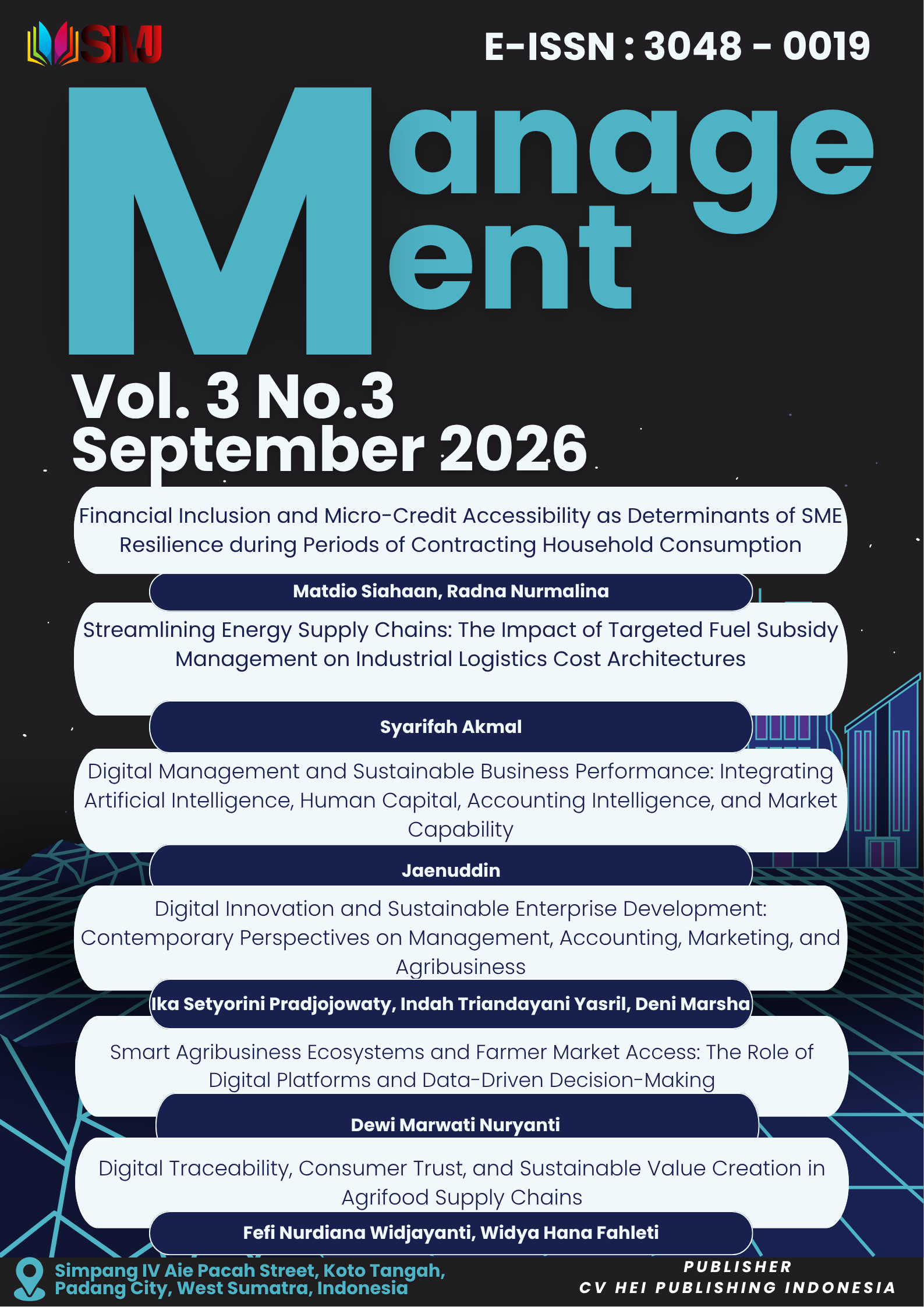
Financial Inclusion and Micro-Credit Accessibility as Determinants of SME Resilience during Periods of Contracting Household Consumption
DOI:
https://doi.org/10.70076/simj.v3i3.211Keywords:
Financial Inclusion, Micro-Credit Accessibility, SME Resilience, Household Consumption, Small and Medium-Sized Enterprises, Financial AccessAbstract
Periods of contracting household consumption present significant challenges for small and medium-sized enterprises (SMEs), particularly through declining demand, tighter cash flow, and operational constraints. In such circumstances, financial inclusion and access to micro-credit may provide SMEs with financial resources that support their capacity to withstand economic pressure and adapt to changing market conditions. This study aims to examine financial inclusion and micro-credit accessibility as determinants of SME resilience during periods of contracting household consumption. The study adopts a quantitative research approach, with data collected from SME owners or managers through a structured questionnaire. Financial inclusion is assessed through access to and use of formal financial services, while micro-credit accessibility reflects the availability, affordability, and ease of obtaining credit for business activities. SME resilience is measured through the ability of businesses to maintain operations, respond to declining demand, manage financial pressures, and adapt to changing market conditions. The proposed analysis examines the individual and simultaneous effects of financial inclusion and micro-credit accessibility on SME resilience. The study is expected to contribute empirical evidence concerning the role of inclusive financial access in strengthening SME capacity to withstand demand-side economic pressures and provide implications for financial institutions and policymakers in designing more accessible SME financing mechanisms.
References
R. Harrison, Y. Li, S. A. Vigne, and Y. Wu, “Why do small businesses have difficulty in accessing bank financing?,” International Review of Financial Analysis, vol. 84, Art. no. 102352, 2022, doi: 10.1016/j.irfa.2022.102352.
R. Amin and V. Viganola, “Financing constraints and firm-level responses to the COVID-19 pandemic: International evidence,” Research in International Business and Finance, vol. 62, Art. no. 101545, 2022, doi: 10.1016/j.ribaf.2021.101545.
N. Zhou and R. Sun, “Coping with the storm: The role of fintech in SME survival,” International Review of Financial Analysis, vol. 93, Art. no. 103157, 2024, doi: 10.1016/j.irfa.2024.103157.
M. R. N. Hilmawati and R. Kusumaningtias, “Inklusi keuangan dan literasi keuangan terhadap kinerja dan keberlangsungan sektor usaha mikro kecil menengah,” Nominal: Barometer Riset Akuntansi dan Manajemen, vol. 10, no. 1, pp. 135–152, 2021, doi: 10.21831/nominal.v10i1.33881.
D. F. Salma, E. R. Cahyadi, and B. Purwanto, “Pengaruh resiliensi Baitul Maal Wa Tamwil, inklusi dan literasi keuangan terhadap resiliensi usaha mikro selama Covid-19,” Jurnal Aplikasi Bisnis dan Manajemen, vol. 10, no. 1, p. 228, 2024, doi: 10.17358/jabm.10.1.228.
M. Widyastuti, D. Y. Y. Ferdinand, and Y. B. Hermanto, “Strengthening formal credit access and performance through financial literacy and credit terms in micro, small and medium businesses,” Journal of Risk and Financial Management, vol. 16, no. 1, Art. no. 52, 2023, doi: 10.3390/jrfm16010052.
F. Manzoor, L. Wei, and N. Sahito, “The role of SMEs in rural development: Access of SMEs to finance as a mediator,” PLOS ONE, vol. 16, no. 3, Art. no. e0247598, 2021, doi: 10.1371/journal.pone.0247598.
T. Kautonen, A. Fredriksson, M. Minniti, and A. Moro, “Trust-based banking and SMEs’ access to credit,” Journal of Business Venturing Insights, vol. 14, Art. no. e00191, 2020, doi: 10.1016/j.jbvi.2020.e00191.
S. U. Khan, “Financing constraints and firm-level responses to the COVID-19 pandemic: International evidence,” Research in International Business and Finance, vol. 59, Art. no. 101545, 2022, doi: 10.1016/j.ribaf.2021.101545.
N. Gür, M. Babacan, A. F. Aysan, and S. Süleyman, “Firm size and financing behavior during COVID-19 pandemic: Evidence from SMEs in Istanbul,” Borsa Istanbul Review, vol. 23, no. 4, pp. 804–817, 2023, doi: 10.1016/j.bir.2023.02.001.
A. Ćehajić and M. Košak, “Bank lending and small and medium-sized enterprises’ access to finance—Effects of macroprudential policies,” Journal of International Money and Finance, vol. 124, Art. no. 102612, 2022, doi: 10.1016/j.jimonfin.2022.102612.
M. H. Saad, G. Hagelaar, G. van der Velde, S. W. F. Omta, and P. Foroudi, “Conceptualization of SMEs’ business resilience: A systematic literature review,” Cogent Business & Management, vol. 8, no. 1, Art. no. 1938347, 2021, doi: 10.1080/23311975.2021.1938347.
F. M. Aragón, A. Karaivanov, and K. Krishnaswamy, “Credit lines in microcredit: Short-term evidence from a randomized controlled trial in India,” Journal of Development Economics, vol. 146, Art. no. 102497, 2020, doi: 10.1016/j.jdeveco.2020.102497.
Z. Z. Mohamas, J. Abu Bakar, Sharmeela-Banu, H. M. Salleh, and K. Ishak, “Pandemic to endemic: A review of key enablers of small medium enterprise resilience,” The Journal of Management Theory and Practice, vol. 3, no. 2, 2022, doi: 10.37231/jmtp.2022.3.2.222.
T. Zhao and D. Jones-Evans, “SMEs, banks and the spatial differentiation of access to finance,” Journal of Economic Geography, vol. 17, no. 4, pp. 791–824, 2017, doi: 10.1093/jeg/lbw029.
Downloads
Published
How to Cite
Issue
Section
License
Copyright (c) 2026 Smart International Management Journal

This work is licensed under a Creative Commons Attribution 4.0 International License.


